
Creating conditions for generosity to thrive

Do we have a strategy, New Zealand?
By Eleanor Cater
16 June 2026
New Zealand is about to experience the largest transfer of wealth in its history. Over the next 25 years $1.6 trillion will pass from one generation to the next as the baby boomers pass on and their estates are inherited. This is an extraordinary moment in time – a unique chance to shape where some of that wealth goes and what it can do for our nation’s future.
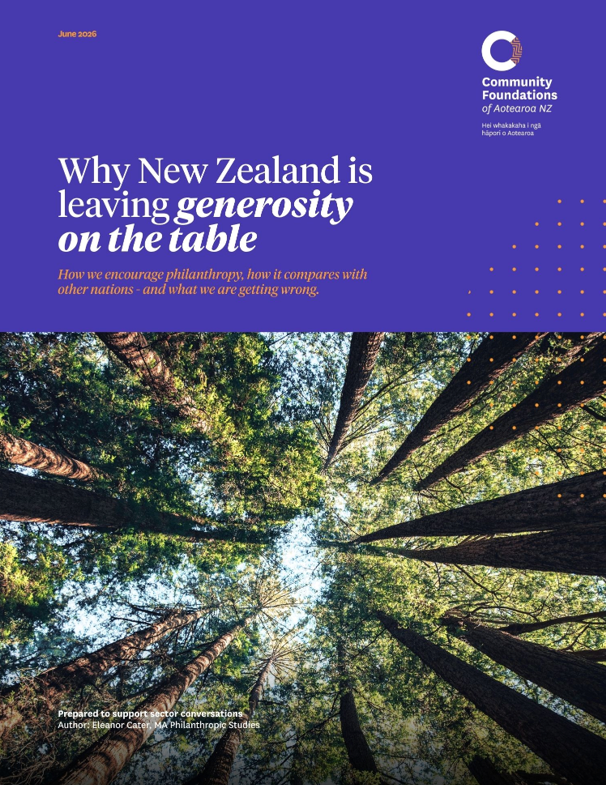
Other countries have seen the wealth transfer coming and have acted. This paper looks at how five peer nations - Australia, Canada, the United Kingdom, Ireland, and Singapore - have settings in place to encourage giving and philanthropy, and how New Zealand stacks up.
The short answer is, not well.
Download the paper here >>
New Zealand's main tool for encouraging giving is a tax credit that gives donors back 33 cents for every dollar donated*. It's a decent credit, but it only applies to cash. You can't donate shares, a heritage painting, or a piece of land and get any special benefit. There's no incentive for leaving a gift to charity in your will. And there's no government programme to help important artworks or cultural objects find their way into public collections through philanthropy. Every other country in this review has at least some of these tools. New Zealand has none of them.
Then came Budget 2026, which capped the tax credit at $100,000 worth of donations per year, which research tells us is likely to change high value donor behaviour. The other five countries reviewed here are moving in the opposite direction, making it easier and more rewarding to give, not harder. New Zealand chose this moment to tighten things up.
Governments incentivise philanthropy for good reasons and international evidence of incentives dates back to Victorian times. When people donate to a cause they're directing money toward public benefit, toward hospitals, arts organisations, environmental trusts, food banks, community foundations. Taxing that act as if it were personal income doesn't make sense. It also ignores the evidence: international research consistently finds that well-designed tax incentives genuinely increase giving, and that the donors most likely to respond to those incentives are precisely the large-scale givers that the Budget 2026 cap will now discourage.
This report recommends that New Zealand develop a ten-year National Philanthropy Strategy in partnership with the sector, remove the $100,000 cap, consider introducing tax benefits for donating shares, property, and cultural heritage items, create a meaningful incentive for charitable bequests and fix the digital and administrative barriers that are providing an obstacle to Kiwis who want to do genuine good.
A debate that stretches far beyond tax
This is a debate that stretches far beyond tax settings; it speaks to who we are as a nation and what we want to become. When Governments apply a lens of ‘tax expenditure’ and measure just the cost - and fail to acknowledge the benefits of a well-resourced community sector and the social cohesion it creates - they are failing to recognize the community building potential of public-private partnerships. And, when politicians and media frame philanthropy – which almost always stems from a deep personal place -as a loophole or a tax dodge, it invites suspicion into one of the few spaces where people act from intrinsic values. It erodes, slowly and invisibly, the trust that makes large-scale and voluntary giving happen at all.
International evidence tells us, where giving is visible and socially reinforced, generosity is nearly three times higher. This is one of the findings from the 2026 World Giving Report, which finds that government leadership is key – people who said their government encourages giving are more generous, more likely to donate to charity, and more likely to have high trust in charities.
The 2026 World Giving Report also ranks New Zealand 70th – yes, seventieth - for giving in the world and, as we continue to slip in the rankings, there is recent research that shows that we are also, increasingly, relying on fewer donors and larger donations.
So, why would we cut the few big givers we have, off at the knees?
Nurturing a culture of giving isn’t a passive act, it’s an action. We have to do things differently if we are to purposefully nurture our giving culture – and we have to get beyond seeing giving incentives as ‘tax expenditure’. There is plenty of evidence from overseas to draw upon to help us develop strategies, and I attempt to outline some of these in this white paper.
The wealth transfer is already underway. The window is narrow to build the policies, infrastructure and the positive narratives that will steer a percentage of it towards public good. What's needed now is strategy and political leadership that will create these enabling conditions for philanthropy to thrive. What an opportunity we have ahead.
_______________________________________
* adding up to the level of total taxable income.
Other reports and links to research and articles of relevance:
- New Zealand's tax credit problem - what the research tells us - Community Foundations of Aotearoa NZ >>
- 10 Budget tax changes for charities and where to from here, Sue Barker Charities Law >>
- Charities, donation caps and the missing analysis, Dr Juliet Chevalier-Watts and Steven Moe (2026) >>
- Taxing giving - why the NZ cap is bad policy, John Godfrey (PhD) >>
- Donation tax credits - whose money is it anyway? Sue Barker Charities Law >>
Date Posted: 15 Jun 2026
Recent Posts
Charity sustainability – are gifts in wills a beacon of hope right now?
13 Aug 2026
Gifts in wills (or charitable bequests) represent a substantial expression of generosity in Aotearoa New Zealand. These estate gifts can be significant in their size, and one single bequest can be changemaking for a charity, with the potential to provide sustainable income into the future...
Read moreTop tips for leaving a charitable gift in your will
10 Aug 2025
Giving gifts in your will is a sensible way to ensure your legacy remains after you pass, and The NZ Law Society shares top tips of the things you need to think of when you are doing so...
Read morePutting a cap on generosity
19 Jun 2026
You will have heard of the remarkable shift that is quietly underway across New Zealand. The baby boomer wealth is on the move - $1.6 trillion, starting its slow shift over the next 25 years. That's houses, farms, businesses, investments and savings that are going to change hands and it's the largest transfer of wealth in New Zealand history. Other countries have spotted the opportunity and acted....
Read more