
New Zealand's tax credit problem

New Zealand's tax credit problem: we know it exists. So why aren't we claiming it?
By Community Foundations of Aotearoa New Zealand
13 May 2026
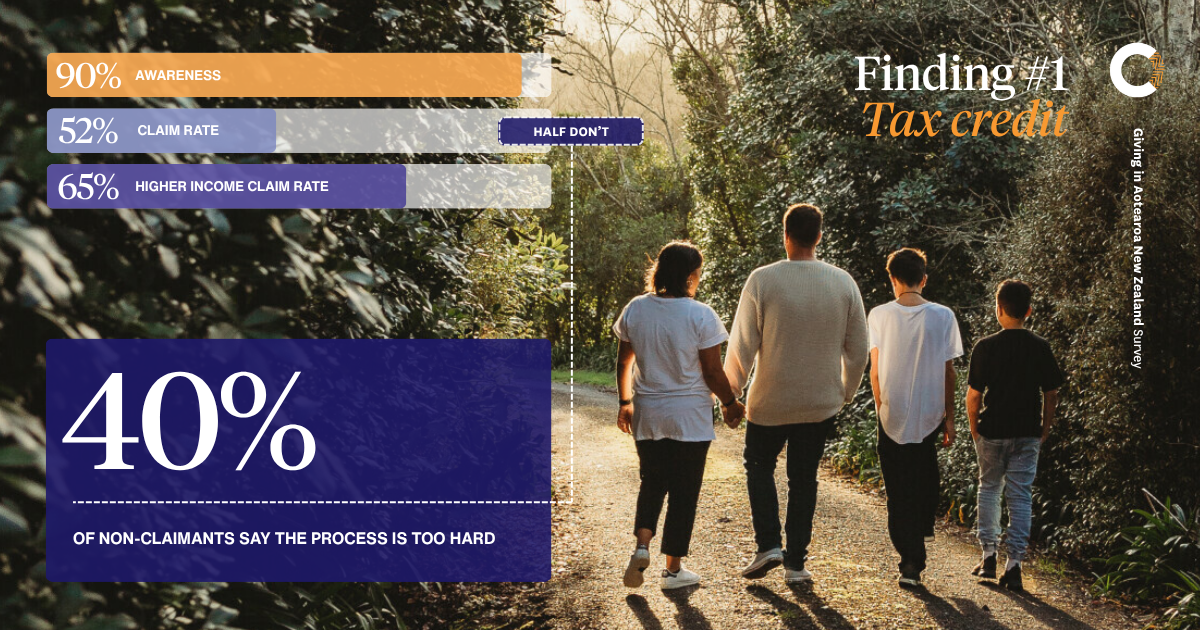
9 in 10 New Zealanders know about the 33% tax credit on charitable donations. Around half claim it. And 40% of those who don't say the reason is simple: it's too hard.
These are some of the findings from our Giving in Aotearoa New Zealand research, and they point to something that should concern anyone who cares about equitable outcomes in communities and having a system that creates optimal conditions for New Zealand's generous culture to thrive.
New Zealanders are generous people. We give to causes we care about, we volunteer, we look out for our communities. But when it comes to one of the most practical tools available to support that generosity, our 33% tax credit on charitable donations, something is going wrong.
The disconnect is striking. 90% of New Zealanders are aware the rebate exists. Yet only 52% claim it. That's nearly half the country leaving money on the table. Money that, if returned, could fuel even more giving.
So, what's getting in the way?
When we asked those who don't claim the credit why not, the answer was telling: 40% said the process is simply too hard. Not that they didn't know about it. Not that they didn't want it. The system itself is the barrier.
An outdated system in a digital world
The donation credit process in New Zealand has seen little meaningful change since the mid-2000s. In the same period, we've seen the rise of contactless payments, instant bank transfers, digital tax returns, and app-based giving platforms. The infrastructure for a frictionless experience exists.
Imagine a world where your tax credit arrived automatically, or at least with a single tap, rather than requiring you to gather receipts, complete forms, and wait. The technology is here; the will to shift outdated systems is what is needed.
What would change if we fixed this?
More people claiming the credit means more money flowing, and it also sends a powerful signal: your generosity matters, and the system supports it.
Research across the world tells us that the tax credit can be a powerful enabler for more giving. A streamlined, near-instant credit system wouldn't just reduce administration, it would make generosity more equitable, reinforcing participation across all income groups, not just those with the time and resources to navigate the system.
Reducing friction in the tax credit process isn't just an administrative improvement. It's a statement about equity and about who philanthropy is for, and it's central to whether the system does, in fact, encourage even more generosity.
What would it take to modernise New Zealand's donation tax credit system?
Summary of Giving in Aotearoa NZ research findings: New Zealand's tax credit
Awareness of the donation tax credit is high: 89.9 percent (n=2,327) reported being aware they can claim a 33⅓ percent tax credit on eligible donations, while 7.5 percent (n=193) were not aware, and 2.6 percent were unsure (n=68). Among respondents who were aware of the donation tax credit, 52.0 percent (n=1,351) reported claiming it in the last three years, while 48.0 percent (n=1,247) had not claimed it. For those who did not claim, the most common reasons were that the process was too hard or required too much effort (41.6 percent), they did not keep receipts (28.9 percent), or they preferred not to (24.1 percent). Around 20.0 percent reported they did not know how, and 12.0 percent said their donations were not eligible.
Awareness of the donation tax credit by age. Awareness is much higher among older respondents, with 97.3 percent of those aged 75 and over aware of the tax credit, and more than 90 percent of those aged 45 and over also aware. By contrast, awareness is much lower among younger respondents, falling to 36.7 percent among those under 25 and 77.4 percent among those aged 25 to 34. Claiming the credit increases steadily with age. Just 11.4 percent of respondents under 25 reported claiming the credit, compared with 29.0 percent of those aged 25 to 34. The share rises further through the middle age groups, reaching 54.3 percent for those aged 45 to 54 and 55.1 percent for those aged 65 to 74, before peaking at 61.4 percent among respondents aged 75 and over. Overall, the pattern suggests that older respondents are much more likely to claim the tax credit than younger respondents.
Awareness by household income shows a different pattern to that of age. Awareness is high across all income groups, with more than 85 percent of each group aware of the tax credit. The two highest income groups are among the most aware, at 95.5 percent for those earning $150,000 to $199,999 and 96.4 percent for those earning $200,000 or more. Awareness is slightly lower and more uneven across the middle-income groups, but remains high overall.
Claiming the tax credit also varies by household income. Around 28.2 percent of respondents in households earning under $30,000 reported claiming the credit in the past three years, compared with 67.4 percent of those earning $200,000 or more. Claiming generally rises with income, although the pattern is not perfectly linear across the middle-income bands.
Among younger respondents, the most common reason was not knowing how to claim it, with 66.7 percent of those under 25 giving this response. For respondents aged 25 to 34, the process itself becomes a more important barrier, with 47.0 percent saying it was too hard or too much effort, and 37.9 percent saying they had not kept receipts. Across older age groups, these barriers remain important, but they gradually decline in prominence. Overall, the findings suggest that awareness of the tax credit is high among older and higher income respondents, but claiming is still shaped by practical barriers such as not knowing how to claim, the effort involved, and keeping receipts. The results point to a gap between awareness and action, particularly among younger respondents.
Conclusion: Tax incentives are underused: Almost all respondents (≈90 percent) know about New Zealand’s 33 percent donation tax credit, yet only about half actually claimed it in the past year. These gaps are particularly stark for younger adults and lower-income households. Many who skip claiming say the process is too much effort, suggesting that simplifying this could help more people benefit and possibly encourage additional giving.
This is the first in a series of findings from CFANZ's Giving in Aotearoa New Zealand research. Stay tuned for more insights into how and why New Zealanders give, and what barriers get in the way.
Date Posted: 11 May 2026
Recent Posts
Media Release: New research suggests brighter times ahead for charities from gifts in wills
21 Aug 2026
New research released by Community Foundations of Aotearoa New Zealand (CFANZ) suggests that charitable gifts in wills are of significant interest among New Zealanders who already give to charity, and local charities are set to benefit. The CFANZ survey of over 3,000 New Zealanders across different regions, ages and incomes was carried out by independent research consultancy BERL and found that 52.3% were interested in the idea of leaving a gift in their will to charity, with 17.4% indicating that they have already done so.
Read moreKiwis are interested in gifts in wills
17 Aug 2026
New research from BERL, commissioned by Community Foundations of Aotearoa NZ, has found that more than half of the 3,000 New Zealanders surveyed are open the idea of leaving a charitable gift in their will...
Read moreCharity sustainability – are gifts in wills a beacon of hope right now?
13 Aug 2026
Gifts in wills (or charitable bequests) represent a substantial expression of generosity in Aotearoa New Zealand. These estate gifts can be significant in their size, and one single bequest can be changemaking for a charity, with the potential to provide sustainable income into the future...
Read more