What the data tells us about volunteering and why it matters

14 June 2026
For National Volunteer Week
By Michelle Kitney, CEO Volunteering New Zealand
and Eleanor Cater, CEO Community Foundations of Aotearoa NZ
Every year, National Volunteer Week gives us a moment to pause and say thank you. But this year, we have something more to offer than gratitude. We have data. And what that data is telling us about volunteering in Aotearoa is more interesting, more nuanced, and in some ways more surprising than we expected.
Community Foundations of Aotearoa New Zealand (CFANZ) recently completed a major piece of research into giving across the country, one of the most comprehensive looks at how and why New Zealanders give their time, money, and energy to their communities. This piece draws on the volunteering findings from that research, and we're sharing some of it here in partnership with Volunteering New Zealand because we believe the insights belong to the whole sector.
What follows isn't a list of statistics. It's a look at what those statistics are actually saying: what they reveal about identity, community, culture, and what drives people to show up.
The Giving in Aotearoa NZ Survey found that 75% of New Zealanders gave their time in the past year: formally, informally, or both.
Volunteering in Aotearoa is the norm, not the exception
Let's start with the headline. Three quarters of New Zealanders volunteered in the past year. In any given four-week period, 61% are volunteering formally through an organisation, and 35% informally: helping neighbours, showing up for whanau, organising something in their community without a registration form or a role title.
That second number matters. Official statistics tend to capture formal volunteering reasonably well. Informal volunteering, the kind that doesn't happen through an organisation and may not get counted in registers, is harder to measure, and is often underrepresented in sector data. Our research suggests it's vast.
"Informal volunteering is vast. Our research suggests it has been significantly undercounted."
This isn't a critique of existing data collection. It's a prompt for the sector to ask whether the questions we've been asking are capturing the full picture of how Aotearoa gives our time.
We give because of who we are, not what we get
When we asked people why they volunteer, the answers were clear and consistent. Nearly 70% said volunteering is part of their values. 61% cited belief in the cause. 56% named manaakitanga, which they described as care and generosity toward others, as a core motivation.
What's notably absent from the top of the list: CV-building, free time, or external incentives. New Zealanders are not volunteering to get something. They're volunteering because giving is part of their identity, and because they feel a genuine sense of responsibility to the people around them.
For Volunteering New Zealand, this confirms something we see in our work every day: volunteering is fundamentally relational. It's not a transaction but an expression of connection. People volunteer because community matters to them, and because showing up is how they live that out.
Many of today’s volunteers are seeking roles that align with their personal values. People are increasingly choosing not to volunteer with big-name organisations in favour of smaller organisations that align better with their own values and social priorities.
Maori and Pacific peoples are giving more than the official data shows
This is perhaps the finding that most warrants attention from the sector.
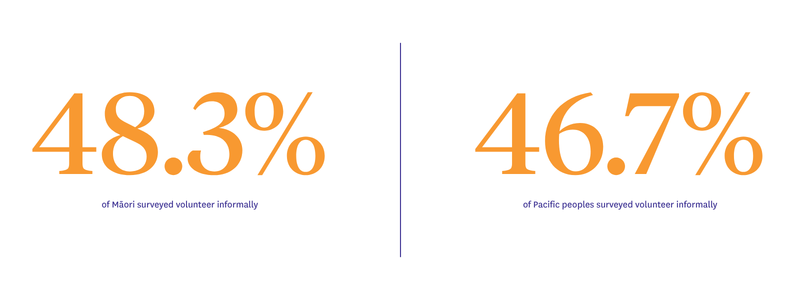
Māori respondents had the highest informal volunteering rate of any group at 48.3%, compared to 46.7% for Pacific peoples and lower rates among other groups. And when Māori and Pacifica people do volunteer, they go deep: both groups are significantly more likely than Pakeha/NZ European respondents to give 25 or more hours per month.
1 in 4 Maori and Pacific volunteers give 25+ hours per month.
This is not a small difference. It points to something that researchers of indigenous giving have observed globally: that for many Māori and Pacifica communities, care and contribution are woven into the fabric of daily life. They are ways of being.
What's significant here is that this giving might not be captured in official data. It often happens outside organisations, outside registers, and outside the definitions that formal volunteering frameworks tend to use. The sector needs to ask itself how we can better recognise, resource, and celebrate forms of giving that don't fit the standard mold.
"Manaakitanga is not a programme. Whanau-centred giving is not a strategy. They are ways of being."
Faith communities are a quiet engine of volunteering
Another finding that stands out: the relationship between religious identity and volunteering is stronger than most sector conversations acknowledge.
88.9% of Muslim respondents said volunteering is part of their values, the highest of any group in the study. Buddhists followed at 73.3%, Christians at 72%. Across almost every faith tradition represented in the data, religious identity correlates strongly with giving time to community.
For many New Zealanders, volunteering isn't a separate activity from their faith. It is the practice of their faith, an expression of values lived out through service. This is a thread that formal volunteering frameworks often miss entirely, yet it represents a significant and deeply motivated segment of the volunteer workforce.
Young volunteers: skills and belonging, not just cause
A note of caution first: the under-25 sample in this research is small, and the findings should be treated as directional rather than definitive. But we think they are worth paying attention to.
Around half of younger volunteers said they gave their time to use or develop skills. Around a third cited social connection as a key motivation, specifically meeting people and building community. The cause still matters. But for younger people entering volunteering, the experience itself needs to deliver something: growth, belonging, connection.
This has real design implications for the sector. If we want to recruit and retain younger volunteers, we need to think carefully about what the experience of volunteering actually feels like, and whether it's building something in the person, not just extracting their time for a purpose.
This is a finding that warrants further research, and we think it's one of the more practically useful signals in the dataset for organisations thinking about volunteer engagement strategy.
The invitation gap: why recognition matters

One barrier stood out as both surprising and actionable: 23% of people who hadn't volunteered said the reason was simply that no one had asked them.
Not lack of time. Not lack of interest. Not an inability to find a way in. Just the absence of an invitation.
"23% of non-volunteers said the reason was simple: no one asked them. That isn't apathy. That's an invitation gap.
This is why National Volunteer Week, and campaigns like The Big Shout Out, matter beyond the obvious. Visible celebration of volunteering functions as a de facto invitation. When people see others being recognised, when they see the scale and diversity of giving in their communities, it lowers the barrier to entry. It makes asking feel normal. It makes saying yes feel possible.
The data also shows that emotional satisfaction is one of the strongest predictors of continued volunteering. People who feel good about giving are more likely to keep giving. Turns out a simple thank you does more heavy lifting than most retention strategies.
What we're taking from this
For both of our organisations, this research reinforces something we already believed but can now say with more confidence: volunteering in Aotearoa is deep, diverse, and driven by values and relationships rather than transactions.
It also raises questions we think the sector needs to sit with. Are we measuring what matters, or just what's easy to measure? Are our volunteering frameworks recognising the full spectrum of how communities give, including the informal, the cultural, and the faith-embedded forms that don't show up in registers? Are we designing volunteer experiences that work for younger people, for Māori and Pacific communities, for people who have never been asked?
We don't think these are rhetorical questions. We think they're central to our nation’s research agenda.
In the meantime: it is National Volunteer Week. This research indicates three quarters of New Zealanders gave their time this year. Most of them did it quietly, without recognition, because it's simply who they are.
That deserves a #BigShoutOut
You can also have your say on what will most improve volunteering with Volunteering New Zealand’s Call to Action survey.
About the authors
Michelle Kitney is the Chief Executive of Volunteering New Zealand, the national organisation for volunteering, and leads The Big Shout Out campaign. www.volunteeringnz.org.nz
Eleanor Cater is the Chief Executive of Community Foundations of Aotearoa New Zealand (CFANZ), the national body representing 18 community foundations across the country. The Giving in Aotearoa New Zealand research project is a CFANZ initiative, in partnership with BERL.
Date Posted: 10 Jun 2026
Recent Posts
Turning lifetimes into legacies
21 Sept 2026
Chris Thomas left his estate to Nīkau Foundation in 2022 to fund conservation work indefinitely...
Read moreWhat holds us together: cohesion, courage and the shifting of power
24 Sept 2026
Every second year our national conference gives us a chance to step back from the daily work of running a peak body for community foundations and ask some bigger questions: what does Aotearoa New Zealand need us to be ....
Read moreWhy your will is about more than your assets
17 Sept 2026
A will decides who raises your children if you can't, and how much certainty your partner has if you're not married. It also decides how much control you get over when your kids actually inherit. Arron Perriam, who advises families on philanthropy and intergenerational wealth at Craigs Investment Partners, walks through why that planning matters. Read it before your next conversation with your lawyer.
Read more