Why bequests matter more than ever

WILLS MONTH BLOG SERIES
During September Wills Month we are sharing thought pieces from our network of member Foundations and supporters.
Matthew Williams
Senior Manager, Philanthropic Services
JBWere
22 September 2025
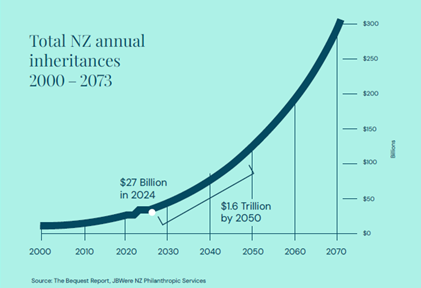
Many New Zealanders give generously during their lifetime, but far fewer think about the impact they can have by including a gift in their will. With $1.6 trillion expected to transfer between generations by 2050, the scale of this opportunity is immense.
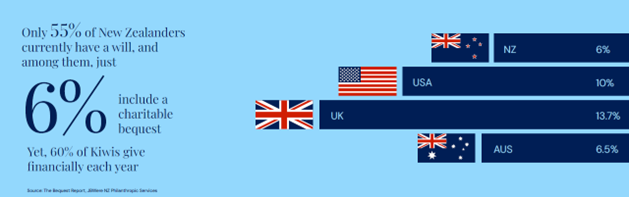
Yet only 6% of New Zealanders with a will currently include a charitable gift, compared with nearly 14% in the UK. Closing that gap could unlock billions of dollars for causes that shape our communities today, and into the future.
A shift charities cannot afford to miss
Even in today’s challenging economic climate, intergenerational wealth transfer continues to grow. This window will not last forever. By 2050, inheritances will peak, and if charities delay, they risk missing a once-in-a-generation uplift in resources. In 2024 alone, $27 billion was transferred. By 2066, annual inheritances will exceed $200 billion. For me, the urgency is clear: if I were sitting around the table with family and friends, I’d say now is the moment to think about what our legacy might be.
At the same time, “everyday givers” are under pressure. Many households still want to support charities, but with tight budgets, regular donations are harder to maintain. That’s why gifts in wills are so important — they allow people to make a lasting impact without affecting day-to-day living.
The opportunities that exist for charities
Bequests provide distinct advantages. They are often unrestricted, deliver stronger returns than other forms of fundraising, and can fund the kind of innovation and resilience that annual donations often can’t. If just 1–2% of estates included a charitable gift, it could unlock an additional $2.5 billion each year. That’s the kind of step change that could reshape the future of our communities.
What practical steps can charities take now ?
From my perspective, the key is not to overcomplicate things. Charities don’t need a 40-page manual — they need focus, visibility, and empathy.
- Be intentional: Think long-term. Having leadership and staff all on board with a bequest strategy makes a difference, invest in your staff long term – legiticmacy of relationship with the bequestor is tantamount.
- Talk openly: Bequests are about life and legacy. Normalising these conversations with supporters helps people see how their values can live on. New Zealand Community Foundation has done great work with ‘Wills month’ over the years use it as an opener or a platform.
- Be visible: Make it easy. A simple webpage, a case study, or even a guide can give donors confidence.
- Honour relationships: A pledge is just the start — keep families connected, respected, and part of the story.
What do we see motivating individuals to include charitable gifts in their wills
Bequests are driven by values and the desire to be remembered for supporting what matters most. For some, it’s medical research, community services, or education. For others, it’s faith, the environment, or animals. Women often play a decisive role — as surviving spouses or as daughters who help guide estate decisions. That influence will only grow, and charities that understand this dynamic will be better placed.
Interesting facts
What stood out to me in the Bequest Report is the power of small shifts. If New Zealanders increased their charitable allocation by just 1–2%, it could mean billions more flowing to causes every year. And while only 1% of bequests are over $1 million, they account for more than half the value. Strikingly, 40% of bequests come from people charities never knew during their lifetime. That tells me brand reputation and trust matter just as much as active cultivation.
Final word
This moment is bigger than numbers. It’s about the values we carry forward and the difference we choose to make when we’re no longer here. The research shows the opportunity is real — but it’s up to us, as individuals and organisations, to act on it.
From building long-term bequest strategies to advising boards on legacy programmes, we work alongside clients to ensure they are positioned to manage their wealth over time, and benefit from this once-in-a-generation shift.
The question for all of us is simple: what story do we want our legacy to tell?
Date Posted: 22 Sept 2025
Recent Posts
Turning lifetimes into legacies
21 Sept 2026
Chris Thomas left his estate to Nīkau Foundation in 2022 to fund conservation work indefinitely...
Read moreWhat holds us together: cohesion, courage and the shifting of power
24 Sept 2026
Every second year our national conference gives us a chance to step back from the daily work of running a peak body for community foundations and ask some bigger questions: what does Aotearoa New Zealand need us to be ....
Read moreWhy your will is about more than your assets
17 Sept 2026
A will decides who raises your children if you can't, and how much certainty your partner has if you're not married. It also decides how much control you get over when your kids actually inherit. Arron Perriam, who advises families on philanthropy and intergenerational wealth at Craigs Investment Partners, walks through why that planning matters. Read it before your next conversation with your lawyer.
Read more